In real estate, the faster a team responds to a new inquiry, the better its chances of keeping that prospect engaged. Buyers often search for properties in the evening or on weekends, and many expect a quick response rather than waiting until the next business day. Research also suggests that leads contacted within five minutes are significantly more likely to convert than those reached 30 minutes later, making 24/7 responsiveness difficult for teams relying only on human agents.
An AI voice agent for real estate helps close this response gap by answering or calling leads, qualifying buyers and sellers, scheduling appointments, updating the CRM, and routing high-intent prospects to a human agent.
According to the National Association of REALTORS (NAR), 23% of REALTORS now use AI tools daily, while 55% say AI has had a positive impact on their real estate business.
Used correctly, voice AI does not replace the relationship side of real estate. It automates repetitive first-touch work so agents can focus on showings, negotiations, follow-up, and closing.
Key Takeaways
- AI voice agents help real estate teams respond to and qualify leads faster.
- They can automate scheduling, CRM updates, and follow-up.
- The best solutions combine natural conversations, integrations, analytics, and human handoff.
- ROI should be tracked through response time, qualified leads, appointments, and missed-call reduction.
- AI works best alongside human agents, not as a replacement.
What Is an AI Voice Agent for Real Estate?
An AI voice agent for real estate is a conversational system that speaks with buyers, sellers, renters, and prospects over the phone using natural language. It can understand questions, collect information, follow qualification logic, trigger actions, and hand conversations to a human when needed.
How Do AI Voice Agents Work in Real Estate?
A typical workflow looks like this:
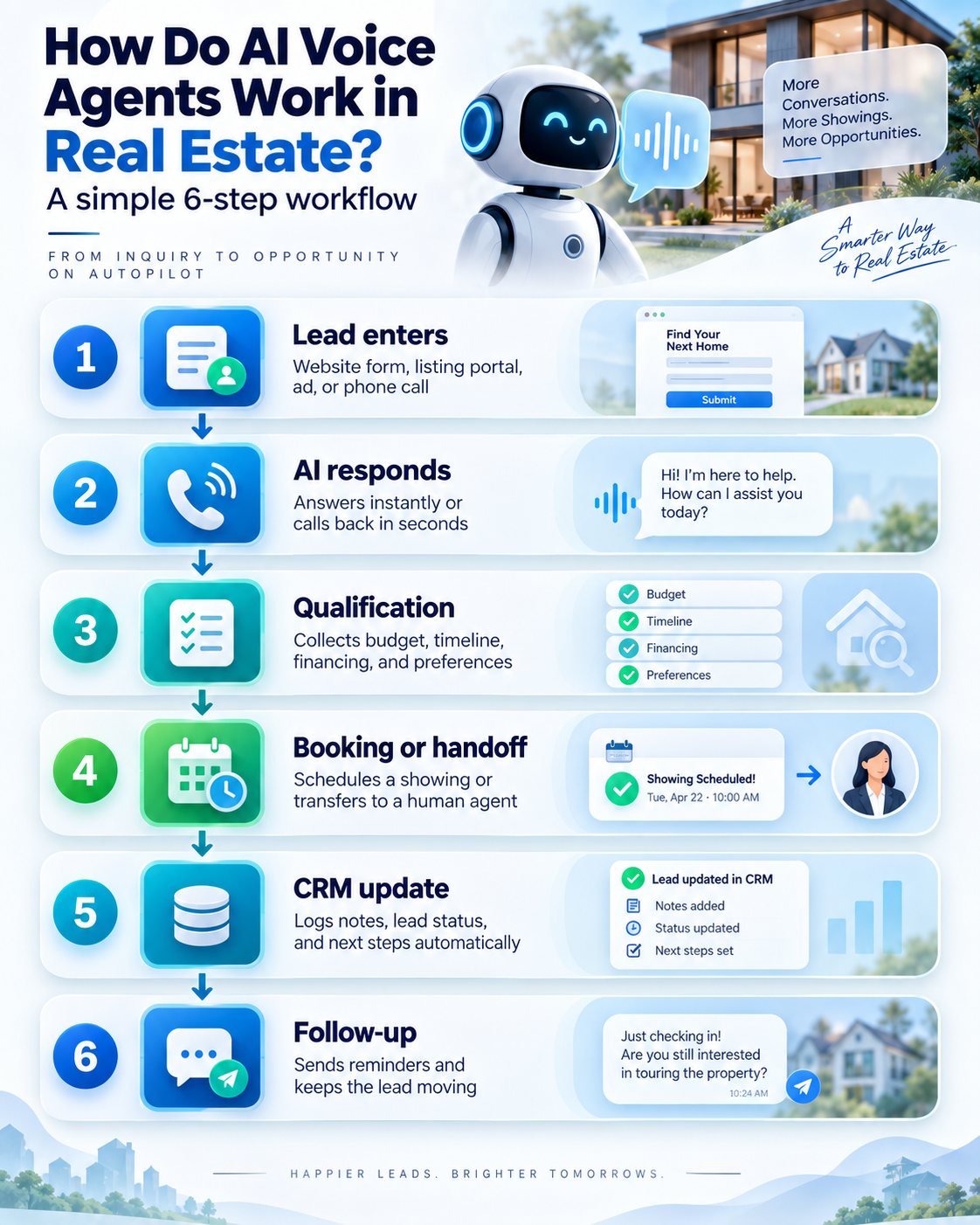
When a new inquiry enters the system, an AI voice agent for real estate can answer the inbound call or trigger an outbound call. The conversation then changes according to the lead type.
For a buyer, the system may ask about budget, financing status, location, property preferences, and timeline. For a seller, it may ask about the property, motivation, condition, expected timeline, and preferred next step.
After the call, the outcome can be sent to the CRM so the lead can be scored, assigned, scheduled, or placed into a follow-up sequence.
6 Ways AI Voice Agents Help Real Estate Teams
1. Respond to New Leads Immediately
Speed matters when several agents may be competing for the same inquiry. An AI voice agent for real estate can engage new leads without waiting for an available team member, including during evenings, weekends, or periods of high call volume.
2. Qualify Buyers and Sellers Automatically
The AI can consistently ask the questions your team needs before a human agent invests time in the lead.
For buyers, this may include:
- Budget or price range
- Financing or pre-approval status
- Preferred location
- Property type and must-have features
- Buying timeline
For sellers, it may include:
- Property details
- Reason for selling
- Property condition
- Desired timeline
- Preferred next step
Separate buyer and seller flows keep conversations relevant.
3. Book Property Showings and Appointments
When connected to a calendar, a voice agent can help schedule consultations, property tours, listing appointments, or callbacks. Instead of ending with “someone will contact you,” the system can move qualified prospects directly to the next action.
4. Handle After-Hours and Overflow Calls
An AI voice agent for real estate can provide coverage when the team is unavailable or when call volume increases. Complex questions, negotiations, legal issues, and sensitive situations should still be escalated to a qualified human.
5. Sync Conversations With Your CRM
A connected AI system can send lead details, call summaries, qualification status, and next steps into the CRM. VoxSun supports CRM integrations including Salesforce, HubSpot, and Zoho, helping teams keep call activity connected with the rest of the sales workflow.
6. Route High-Intent Leads to Human Agents
Good automation should know when to stop. If a prospect is ready to book, requests a human, asks a complex question, or meets priority criteria, the system should transfer or escalate the conversation with context.
The strongest workflow is usually AI for speed and repetition, with humans handling trust, advice, negotiation, and closing.
How Does an AI Voice Agent Qualify Real Estate Leads?
An AI voice agent for real estate can qualify leads through structured questions while adapting to each response.
Buyer Qualification
For buyers, it can collect budget, financing readiness, target area, property preferences, and timeline. A pre-approved buyer who plans to move soon may be routed differently from someone who is only researching.
Seller Qualification
Seller conversations need a different flow. The AI can collect property information, reason for selling, condition, timeline, and whether the seller is ready for a valuation or consultation.
Lead Scoring and Routing
There is no universal scoring formula. Brokerages should define criteria based on their market, inventory, lead sources, transaction value, and sales process.
High-intent leads can be routed immediately, while lower-intent leads can enter nurturing workflows until their needs or timing change.
What Makes the Best AI Voice Agent for Real Estate?
The best AI voice agent for real estate should fit your lead sources, CRM, call volume, markets, qualification process, and human handoff rules.
| Capability | Why It Matters |
| Natural conversation | Makes calls easier for prospects to use |
| Fast response | Shortens the gap between inquiry and contact |
| CRM integration | Keeps lead data synchronized |
| Calendar integration | Supports booking and rescheduling |
| Buyer and seller workflows | Keeps qualification relevant |
| Human handoff | Escalates complex or high-value conversations |
| Multilingual support | Helps teams serve more markets |
| Analytics | Tracks call and conversion performance |
| Compliance controls | Supports responsible calling workflows |
| Reliable telephony | Protects call quality and customer experience |
When comparing the best AI voice agent for real estate options, evaluate how the technology performs during real conversations and how well it connects with your existing workflow, rather than judging it only by a polished demo.
What ROI Can an AI Voice Agent Deliver for Real Estate?
The ROI of an AI voice agent for real estate usually comes from improving how existing leads are handled rather than simply generating more leads.
- Fewer missed opportunities: More inquiries receive a response instead of waiting for a callback.
- Faster engagement: Leads can be contacted while their intent is still high.
- Consistent qualification: Every prospect can follow the same qualification framework.
- Less repetitive work: Agents spend less time on screening, scheduling, and manual data entry.
- More appointment opportunities: Qualified prospects can move directly from conversation to booking.
Metrics Real Estate Teams Should Track
To understand whether voice automation is producing value, measure:
- Lead response time
- Contact rate
- Qualified lead rate
- Lead-to-appointment rate
- Appointment-to-close rate
- Cost per qualified lead
- Missed-call rate
- Human handoff rate
- CRM sync success rate
The goal is not to chase one impressive metric. Instead, look at whether automation improves the complete path from inquiry to qualified conversation, appointment, and revenue.
AI Voice Agents vs Human Real Estate Agents
AI and human agents are strongest at different stages of the customer journey.
| AI Voice Agent | Human Agent |
| Immediate first response | Relationship building |
| Repetitive qualification | Complex qualification |
| After-hours coverage | Negotiations |
| Appointment scheduling | Personalized advice |
| CRM data capture | Deal strategy |
| Routine FAQs | Complex property discussions |
An AI voice agent works best as the first layer of the sales process, not as a substitute for the professional guiding the client through a major transaction.
How to Implement AI Voice Automation in Real Estate?
Start With One Workflow
Begin with a clear use case such as new buyer inquiries, after-hours calls, seller qualification, or appointment booking. Starting with one defined workflow also makes it easier to measure performance before expanding automation across more parts of the business.
Connect Your CRM and Calendar
Define what information the AI can access, what it should write back to the CRM, and what actions should happen after each conversation. A connected workflow prevents agents from having to manually transfer information between systems.
Build Separate Conversation Paths
Buyers, sellers, renters, and investors may require different questions and routing rules. A generic script can make conversations feel irrelevant. Separate flows allow the system to collect information that actually matters for each type of prospect.
Define Human Handoff Rules
Set clear conditions for transfer, escalation, or urgent callbacks.
For example, a lead may need human attention when they request an agent directly, have a complex property question, show strong purchase intent, or enter a negotiation-related conversation.
Test and Optimize
Review calls, transcripts, missed intents, lead outcomes, booking rates, and customer feedback.
The goal is not to create a conversation flow once and leave it unchanged. Continue refining questions and routing rules as you learn where prospects need clearer answers or where valuable information is being missed.
Final Thoughts
An AI voice agent for real estate can help teams respond faster, qualify leads more consistently, automate scheduling, and reduce manual CRM work. The greatest value comes when the technology is connected to a clear sales workflow and knows when to hand the conversation to a human.
VoxSun combines business communications, CRM connectivity, and AI voice capabilities designed to help real estate teams move leads from first contact to the next action more efficiently.
Frequently Asked Questions
Can an AI voice agent qualify real estate leads?
Yes. It can ask structured questions about budget, timeline, financing, property needs, motivation, and readiness, then route the lead according to your qualification rules.
Can AI voice agents book property showings?
Yes. When connected to the appropriate calendar and scheduling workflow, they can help book, confirm, or reschedule property showings and appointments.
Can an AI voice agent integrate with a real estate CRM?
Many platforms can connect through native integrations, APIs, or webhooks. The exact setup depends on the CRM and voice AI provider being used.
Will AI voice agents replace real estate agents?
They are better suited to automating repetitive first-touch tasks than replacing real estate professionals. Human agents remain essential for relationship building, personalized advice, negotiation, complex decisions, and closing.
Laisser un commentaire